EYFS Curriculum
What is The Early Years Foundation Stage?
The Early Years Foundation Stage (EYFS) is the statutory framework that guides learning, development and care for children from birth to five. It provides a strong foundation for future success by nurturing curiosity, confidence and a love of learning, while supporting children’s academic, social and emotional development.
We deliver the EYFS through the CUSP curriculum, which provides a carefully sequenced, knowledge rich approach to early learning. Half termly topics are thoughtfully planned to build knowledge over time, allowing children to revisit and deepen their understanding through meaningful connections.
Our environment is designed to promote choice, enquiry and reflection. Staff skilfully guide learning through questioning, modelling and extending thinking, ensuring that children feel supported while developing autonomy. Leadership opportunities help children build confidence, communication skills and a strong sense of belonging within our school community.
By combining the nurturing principles of the EYFS with the structured, knowledge rich approach of the CUSP curriculum, we ensure that children leave Reception not only ready for Year 1 but equipped with the curiosity, independence and leadership skills that will support them throughout their educational journey and beyond.
There are 7 Areas of Learning and Development:
3 Prime areas and 4 Specific Areas
Children should mostly develop the 3 prime areas first. These are:
- Communication and language
- Physical development
- Personal, social and emotional development.
As children grow, the prime areas will help them to develop skills in the four specific areas. These are:
- Literacy
- Mathematics
- Understanding the world
- Expressive arts and design.
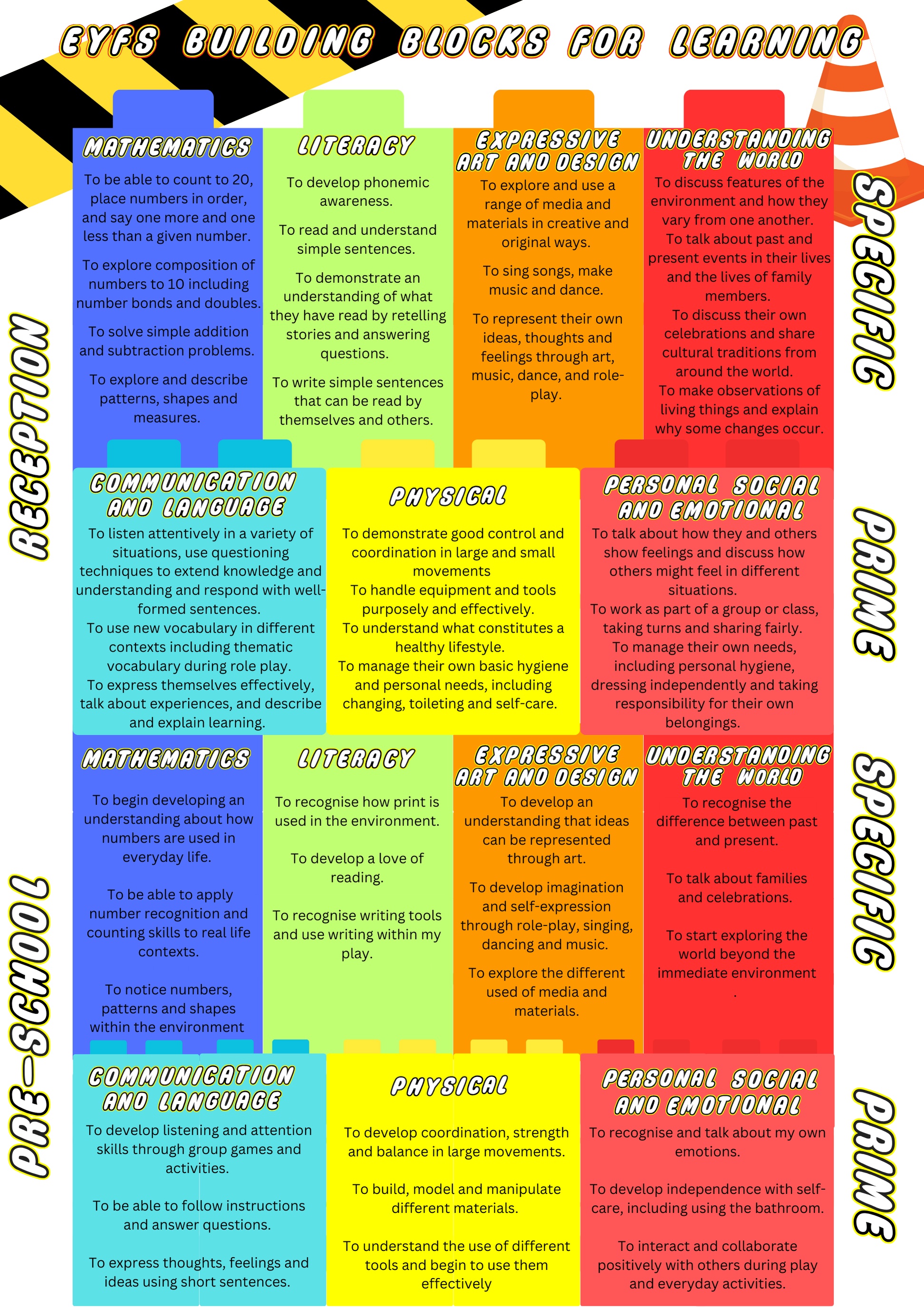
Communication and language development – providing children with opportunities to experience a rich language environment; to develop their confidence and skills in expressing themselves; and to speak and listen in a range of situations.


Physical development – ensuring there are plenty of opportunities for young children to be active and interactive; and to develop their co-ordination, control, and movement. Children are also supported to understand the importance of physical activity and to make healthy choices in relation to food and oral hygiene.


Personal, social and emotional development – supporting children to develop a positive sense of themselves, and others; to form positive relationships and develop respect for others; to develop social skills and learn how to manage their feelings; to understand appropriate behaviour in groups; and to have confidence in their own abilities.


Literacy - supporting children to understand the key concepts of print. Having conversations about texts, learning new vocabulary, exploring phonics, early writing and mark making.


Mathematics - providing children with opportunities to develop and improve their skills in counting, subitising, comparing and using numbers, exploring shape, measure, positional language and pattern.


Understanding the World - guiding children to make sense of their physical world and their community through opportunities to explore, observe and find out about people, places, the past and the environment.


Expressive Art and Design - ensuring children have opportunities to explore and play with a wide range of media and materials, as well as providing opportunities and encouragement for sharing their thoughts, ideas and feelings through a variety of activities including art, music, movement, dance, role-play and design.


